A prayer in the making…

For the past four months I’ve been piecing together a daily prayer to distill the intercession in my heart.   It’s in a state of perpetual refinement, but even so it helps me to stay focused on the primary burdens I carry every day.

Holy Father,

Let the beauty of Your character captivate our hearts
As your glad Kingdom is extended throughout the earth.
Send revival and reformation to the nations.
Raise up your glorious church,
And lay bare the enemy’s schemes of darkness.

Jesus Christ, I am Yours.
Save me to the roots of my being.
Change me where I need changed.
Strengthen me where I need strength.
And break me where I need to be broken.

All my sins, I send to the cross.
All my shame, I send to the cross.
All condemnation, I send to the cross.
And all of my hope I place in the risen Christ.

Work in me Your tender love towards all people;
Instruct me in wisdom, understanding, and insight,
And grace me to receive my inheritance in Jesus.

Teach me, Father, to be a faithful son.
Teach me, Jesus, to be a faithful friend.
And teach me, Holy Spirit, to be a faithful disciple.

Open my eyes to your Kingdom in all its goodness, truth, and beauty.
Give me grace to preach it with power,
To seek it with passion,
To serve it with honor,
And when the time comes, to suffer for it with joy.

For Your glory alone.

Missing pieces: education and worldview


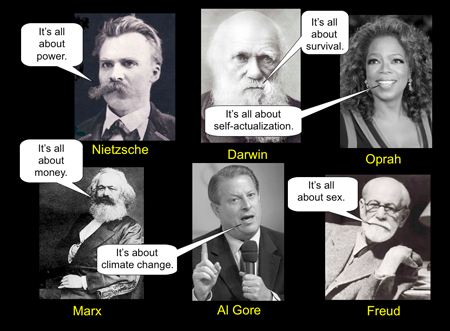
Back in the early seventies I learned at a liberal denominational youth conference that life is really “all about sex.”  No kidding.  One dear counselor casually unpacked the idea that all our relationships, all our dreams, and all our motives were merely hormonal spark plugs firing in our adolescent bodies.  It was so jarring to my impressionable mind that I could barely concentrate on Kum Ba Yah for the next couple of days, until another man stood up and spilled the real beans:  It wasn’t about sex after all.   It’s about racism and the struggle for equality among people.   I didn’t understand at the time that I was being bombarded with worldviews, and non-biblical ones at that.  These were ideas that fell like a fog around my mind.


A worldview is a story line we believe about the world, an over-arching idea that organizes our experiences into a meaningful whole.  If life truly is about hormones, then that explains a few things about why I do the things I do.  But if it’s about racism, then it explains other things.  Virtually everyone  believes some sort of story about the world.  It’s nearly impossible to live in a world of random pieces which cannot be assembled into a story line.  Marx’s story was about wealth and freeing ourselves from the damnation of capitalism.   Margaret Sanger’s story is one of sexual liberation and emancipating ourselves from old fashioned morality.   Timothy Leary told a story about the promise of drugs and flower-power to redeem the world.


But of course the real question concerns the truthfulness of the story we believe.  Any old story will do to a point.  But only the True story will bring all the pieces together into a coherent whole.  And of course the only person who can verify the correct story is the Author who brought it all into being in the first place.   “Once upon a time”, (“In the beginning”), is the platform upon which the whole story will be built, and if we begin on a faulty foundation it’s a sure bet the whole system will crumble at some point.

Modern Western education is a house built on the sand of a false beginning.  It’s all well and good to fill young minds with stories of man’s descent from primates until you expect him to act like a human being, and not steal the banana you brought for lunch.   It all works well enough until those eighth grade primates begin to actually believe the idea that there really is nothing special about being human, and succumb to depression and suicide.  Who’s to say we should work and not live off the government?  Who’s to say we shouldn’t cheat our way through school?  Who’s to say we shouldn’t accept bribes or steal the neighbor’s vegetables from his garden?   Because if it’s all about sex, money, power, drugs, climate change, racism, or tolerance, then I’ve got quite the latitude to invent any old story I choose.  And society begins to crumble.

Missing Pieces: goodness, truth, and beauty.

It’s been a delightful week here in Kona, (The University of the Nations), in a class of wonderful students grappling with the Kingdom of God.

When the first Universities, (Paris and Oxford), were founded in the twelfth century they featured a curriculum which focused on the three absolutes of Goodness, Truth, and Beauty.   Within that academic trinity can be found all the glories of ethics, law, science, philosophy, and the creative arts.   And when taken together the absolutes point to the wonder of God’s Kingdom.   “Finally, brothers, whatever things are true, whatever things are honorable, whatever things are just, whatever things are pure, whatever things are lovely, whatever things are of good report; if there be any virtue, and if there be any praise, think on these things.” (Philippians 4:8)   To sit in holy wonder before these absolutes is to seek God’s kingdom.

That’s a fair summary of what we did in class this week:  We examined beauty, truth and goodness, identified them as reflections of the Trinitarian God,  surveyed a few of the ways these absolutes are under attack, and reminded ourselves that the Father of Jesus will not be satisfied until every lost glory of His Kingdom is restored.   And that, I believe, is a true education.

Missing pieces: a return to school

Hopefully my friends will forgive me if I confess that the reason I haven’t written lately is because I stumbled briefly into a swamp of despair.   My heart got slimed by news and politics and I lost sight of the dreams and promises of God.  But today I’m returning to the only foothold I can find in this messed-up world: the certain reality of Jesus and his kingdom.

I left off talking, (in “Missing Pieces“), about how the kingdom might influence the sphere of education.   With America spending in the neighborhood of 100 BILLION dollars per year on education, our schools remain in a state of crisis.  One National Geographic survey shows the disturbing trend that when American 18 to 24-year-olds were given world maps,

  • 87 percent could not find Iraq
  • 49 percent could not find New York
  • 11 percent could not find the United States

With such shocking results in a field as objective as Geography, who wants to even imagine our command of  Truth, reasoning, and understanding of the world itself?   In the diagram below the yellow circle represents Truth, which  ALWAYS produces life.  The red circle represents our beliefs.  Notice that when our beliefs intersect with Truth, the result is knowledge and life.  But when our beliefs fall outside the scope of Truth they produce death, whether it’s mathematical, scientific, psychological or spiritual.   Hosea 4:6 tells us “My people are destroyed for lack of knowledge…”

So how would the Kingdom influence education?  Just a few thoughts:

1. The church would repent of it’s narrow message which idolizes “personal salvation” and “getting into heaven” to the neglect of “Thy Kingdom come, Thy will be done on earth as it is in heaven.” Personal salvation is the entry point into the kingdom, (John 3:3), but it is not the end-all of the gospel.   The church must re-embrace the entire gospel, which declares a kingdom plan for every sphere of life from schools to science, from films to families.  (Eph. 4:10)

2. The basis of Education would return to the focus of “These things are True,” rather than “This is the stuff you should know in order to enter the job market.” We are not perishing for lack of information and opinions, but for the lack of Truth.

3. Parents would assume the God-given responsibility of teaching their children.  “Teach these things to your children, and talk about them when you’re at home or away, when you lie down or get up.” (Deut. 11:19)  That doesn’t mean we need to home school every child, but that parents, (and not the government), should assume a primary role in educating their children.  When we allow the direction of our schools to be dictated by government bureaucrats we get exactly the kind of students we have today, who can’t locate America on an unmarked map.

4. Schools, (both public and Christian), would turn their focus from teaching students what to think, to training them how to think; how to assess truth, how to reason, how to employ logic and exchange ideas in constructive and meaningful dialogue.

One more idea I’ll save until next week.

Travel, fear and hope.

Just a very quick note to mention that I’m on my way to Central Europe, and hope to update from there soon.   I’ll be teaching in Hungary, Romania, Macedonia, Hawaii, and Colorado in the next six weeks, and would appreciate prayers for effective communication, the freshness of the Kingdom message, and of course for all the issues of travel.

Hopefully this trip will be a respite for my spirit, which has been so heavy these past weeks.  There’s an unnamed fear that ambushes me daily in regard to America, and it’s been a constant battle to maintain hope in the midst of the “fundamental changes” in our freedoms, alliances, and national security.

Still… my confidence is in the promise of God’s Kingdom, and the Truth of His Word.   When everything else unravels at the seams, His promise and His Word remain.

Alice in Wonderland and the Kingdom of God (a diversion from “missing pieces”)

All the political dialogue the past few days makes me just want to step outside and spit.  I need a breather; need to write about something less intense.  And since several have asked about Kingdom themes in Alice in Wonderland,  I think I’ll have a go.   The new Disney movie is my one and only exposure to Wonderland, so please be forgiving if I miss something or get it all messed up.

God writes His kingdom story into every human heart.  He seems to imprint it on our DNA as a way of drawing us back to Himself and into His own epic Story.   In fact I’m quite certain that we humans judge the merits of our stories by how much they resonate with the kingdom template imprinted in our genes.   Alice certainly had the Story written in her heart from her earliest memory, and when at last she entered Wonderland, she knew exactly where she was.  She had “been there” all along in her dreams.

Here at the bottom of the rabbit hole is a kingdom that has fallen, much like planet earth, under the power of an evil ruler.   The land has been ruined and it’s creatures terrorized by the manipulative Queen of Hearts.  “Off with their heads” to all who resist her demands.   The kingdom needs rescuing, and not just anyone can do it.

So Alice is summoned from the outside world, much like Christ, to enter into the kingdom with a clear purpose of redeeming it. Even the Rabbit-hole prophets have foretold it all in their ancient scroll.  Like Jesus, Alice befriends the creatures of Wonderland, and because of her love for them, (especially the Mad Hatter), hazards the castle of the Queen of Hearts on a daring rescue mission.

Much like Satan, the power of the Queen is merely an illusion.  It’s a pretense of power backed only by her control of the Jabberwocky.  And of course the Jabberwocky is very much like the beast of Revelation 19.   The story culminates with Alice confronting the beast in faith, (“Sometimes I believe as many as six impossible things before breakfast”), and victoriously bringing it down to destruction.  With evil dethroned, and the creatures of Wonderland liberated from slavery and fear, we’re left with the distinct image of Wonderland restored in “righteousness, peace, and joy.” (Romans 14:17)

Did Lewis Carroll consciously incorporate these Biblical images into his story?   I doubt it.  Most story writers have no such intention.   But the fact is, it’s nearly impossible to write a good story without rich images of the Kingdom.  The heart understands these things even when the mind misses it.

Missing pieces: freedom, truth, and education.

I’m stunned by the “fundamental changes” that have transpired in America in only a few short weeks since we began looking at  government and the Kingdom of God.  It’s for you to decide what to make of it all, but I encourage you to review the relationship between civil government and self government before asking yourself, “Have we stepped forward into fresh freedoms and responsibility, or deeper into the path of slavery and increased government control?”

Since Truth is the defender of freedom, and education is the guardian of Truth, this is probably a good time to ask what the sphere of education might look like in a Kingdom context.  Jesus told us in John 8:31-32 that if we would continue in His word, we would “know the truth, and the truth will set you free.” It’s no accident that God’s plan to deliver the Israelites out of slavery to the Egyptians involved both the exodus into the wilderness and the giving of His law on Mt Sinai.  And then He charged them,  “Study this Book of the Law continually.  Meditate on it day and night so that you will faithfully do everything written. Only then will you prosper and succeed.” (Joshua 1:8)

Truth is the foundation for prosperity and success.  All success.   Whether it’s music, mining, mentoring, or mathematics, the degree to which we honor truth will determine the success or failure of the operation.  It’s like the two trees below.  Imagine the tree on the left is watered with kerosene and fertilized with salt.  That’s not a “true” environment for a tree, and the result is certain death.  But the second tree grows in an environment of truth, watered by the rain, and fertilized with compost and nitrogen.   Truth invariably produces life, and anything short of truth results in death and decay.

God has not left us wondering about truth, but has  revealed it plainly in His word, His world, and His Son. And though Truth is intended to be the focus of education, it has sadly been relegated to secondary status behind information, opinion, and power.   We’ll pursue some of the problems and possibilities next post.

On a personal note, I went to see Alice in Wonderland last night and caught myself spontaneously cheering at some of the Kingdom moments.  (I just can’t help it.  Kingdom Truth makes me happy.) “Sometimes, (Alice said), I’ve believed as many as six impossible things before breakfast.” All Truth is God’s truth, even in Wonderland.

Missing pieces: sovereignty and freedom

Before leaving the sphere of government, there is another important question that must be addressed, and that is the question of Sovereignty.  To whom do we turn as the ultimate authority, the One who will answer the question, “How shall we live?” I can think of only three options:  The sovereign individual, the sovereign state, or a sovereign God.

WHEN THE INDIVIDUAL IS SOVEREIGN:
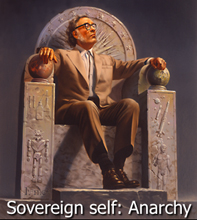
If the individual is sovereign, that is… if I make up the rules for “my world” and my neighbor makes up the rules for his, we invite conflict because there’s really only one common world, and if every person makes up his own rules there will be nothing to hold communities together.  It’s all well and good, (up to a point), when we each live as we choose in our own home.  But once I step into the street there must be a common understanding of the world we live in; of it’s morals, ethics, laws, and values.

Nature itself shows us a world of common laws which bring order to human existence: sowing and reaping, mathematics, gravity, motion, etc.  Existence without unifying laws equals chaos.  When the individual is sovereign, anarchy reigns.  And anarchy simply doesn’t work.

WHEN GOVERNMENT IS SOVEREIGN:
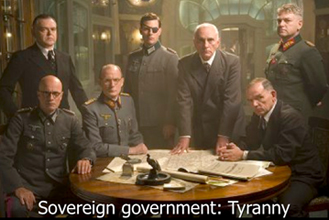
In today’s culture we’re more likely to choose the alternative route of the sovereign State who, like a kindly older brother will arbitrate disputes and make choices regarding justice, fairness, and life together.  Certainly this idea has been tried from the Pharoahs of Egypt to the Parliaments of Europe.  And it even seems to have some success for awhile.

In a Utopian world where man and motives are pure-hearted and true, the sovereign Government might work.  But in this case both human nature and history testify against us.  Humans in the real world are corrupt and greedy by nature, and the more power they’re given the more greedy and corrupt they become.  Apart from a higher accountability Governments inevitably fall into immorality and blind ambition.  Never in human history has a government, adrift from God, sustained itself in goodness and benevolence towards its people.  We are witnessing at this very moment, the slow, steady decay of the free world into corruption and greed.  The sovereign government is a tyrant.  And if it isn’t today, left unchecked by a higher Truth, it will become one tomorrow.

WHEN GOD IS SOVEREIGN:

Which brings us to the remaining option, the only one which offers both freedom and order in a world of diversity.  If God is sovereign, and if we understand His true nature as a Servant-King, He unifies nations with love, orders them with justice, and liberates them with true freedom.  Jesus demonstrated the true heart of government which values not the strong arm of power, but the beauty of selfless service to its neighbor.  This is the government of the Kingdom, and the closer we come to that model, the more freedom and life we will enjoy.
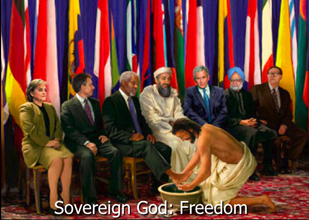

“He has shown you, O Man, what is good; and what does the LORD require of you, but to do justly, and to love mercy, and to walk humbly with your God?” – Micah 6:8

———————-

(Much of my understanding of government comes from my friend Bill Burtness and his wonderful book, The Third Alternative.  I highly recommend it as a primer for Biblical government).

Missing pieces: grace and government

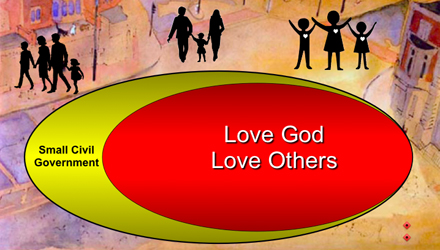
Grace is God’s empowering presence at work within a person to justify him and make him what God intended him to be.  It was always the plan of the Father to govern men by grace, by His love written in our hearts.   And the more a culture, a community, or a nation is governed by grace-full hearts of love, the fewer external laws are necessary.   In such a case, all that is needed to maintain the common goals and good of the community is a minimal civil government.  It might look like this:

But when grace is abandoned, and the love of God and others runs dry, the civil government by necessity must step up and expand in order to maintain order:  Laws replace love, courts replace courtesy, policemen replace parenting, and freedom is lost.   This is the sad condition of western civilization..

What’s needed in today’s culture is a return to the simple law of the Kingdom.  If we were to once again embrace the love of God and others, much of the government’s burden would be handed back to individuals, and the cry for a nanny state would cease.

Deuteronomy 1:13 instructs us in several additional principles of Civil Government:  “Choose some wise, understanding, and respected men from each of your tribes, and I will set them over you.” Notice these three principles:

  • The people should choose their leaders.  (That’s democracy).
  • They should choose leaders from their tribes: (This is local government, leaders who are known.)
  • They should choose leaders of wisdom and good character.

What I’m trying to show in these simple posts is that God’s kingdom plan addresses all of life.   Kingdom people understand that the gospel is more than forgiveness alone; It is a way of life that includes everything from business to baseball, from homelessness to health care.

On a personal note, I’m back in Maryland after a delightful weekend with the men of Shepherd Gate Church in Chantilly, Virginia.   I spoke on “Identity and the Kingdom of God,” and had a rich time of friendship and challenge with these amazing brothers.

Ranting about grace (a quick detour from “missing pieces”)

The past four weeks I’ve been teaching a class on the scandalous, outrageous, shame-scrubbing, mind-boggling, spirit-enabling grace of God.  It’s diverted me for a moment from this present focus on the missing pieces of the gospel.  But then again, the neglect of grace rightfully ranks as possibly the most important “missing piece” of the gospel.

We speak poetically of grace, and offer it in generous portions to our wayward friends. But too often the grace-well dries up about the same time the church door closes behind us.  “That was for then, brother.  Now we’ve got standards to keep.  You gotta work hard, stay sanctified, tow the line, and put on a happy face now that you’re a church member.  We’re not interested in your issues, addictions or dirty laundry, and if you can’t measure up, then you’ll just have to either leave or pretend.   (Uh… most of us choose to pretend, by the way).

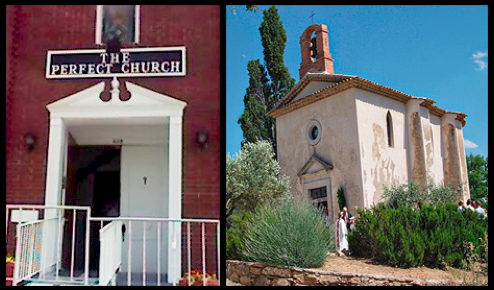
One of my friends recently told me about driving through the rural South and coming upon “The Perfect Church.”  No kidding,  the sign was right out in front declaring it before God and everyone else.  That’s definitely not the church for me.   I’m a saint with issues, and I need boatloads of grace every day of my life.   I’d be heaps more comfortable in the leaning chapel next door.

If I can move past grace we’ll return to the missing pieces next post.