The little village that changed the world

Herrnhut, Germany

I just arrived in Sarajevo from Herrnhut, Germany, sometimes known as “the little village that changed the world.”  It’s the home of Count Nicolaus von Zinzendorf and the Moravian Brethren.  These were the people who launched the modern-day missions movement with a legendary zeal that has seldom been equaled.   Sometimes even selling themselves into slavery for the Gospel, the Moravians packed their meager belongings into their coffins and set off for foreign lands from Labrador to Egypt, Suriname to South Carolina.   These were the same people who famously influenced John Wesley in his search for faith and who began a prayer movement that for 100 years maintained around the clock prayer for churches, missions and the advance of the Gospel.

In the early seventeen-hundreds refugees from numerous Protestant sects in Moravia and Bohemia, (present-day Czech Republic), fled to Saxony asking Count Zinzendorf for asylum from their persecutions.  The godly count welcomed them onto his estate and charged them to lay down their doctrinal differences for the cause of Christ.  He offered them a corner of his property and invited them to settle in what is now Herrnhut.

Zinzendorf was a broad-minded believer who championed the grace of God and the unity of believers above divisive doctrines.  So it was a perfect setting for YWAM to pioneer it’s first eight-week “School of the Kingdom.”   In the tradition of the Moravians, one of this week’s students shared his story of taking an outreach team into a rebel militant camp in Nigeria, and leading fifteen of the soldiers out of the camp and into faith in Jesus.

It was an amazing week of grace and learning in a setting that has earned a special place in history.  And now I’m back in wonderful Sarajevo, with a very different and almost opposite history.  More on that later.


A part of Zinzendorf’s Estate

Sin hammer

I’m convinced the “sin hammer” is a major distraction from the Kingdom of God.  Never heard of the sin hammer? Then let me explain: It’s the handy tool that’s often placed in the hands of fresh, young believers when they turn their faces towards Jesus; the alien idea that the essence of Christianity is the eradication of sin.

“Look here, son. Now that you’re a believer, there’s something you need to know:  Your focus now is to eradicate sin everywhere you find it.”

“See it around you in your community?  Then hammer away!!”

“In your neighbor?  Then whump it hard!  Your mission is to expose it, judge it, and stomp it out anywhere you find it because – make no mistake – it is EVERYWHERE!”

“See it in your own life?  Shame on you!  Grab that sin hammer, roll up your sleeves and go to work until it’s pulverized and dead.”

Now obviously we ought to hate sin. None of us who share in the life of Jesus should feel any tenderness towards the cosmic poison that cost the life of God’s Son on the cross.  But the problem with all this focus on sin is exactly that – that sin, (and finding freedom from it), has become the focus!  And soon we have a whole army of Evangelicals hammering away at everything around them, including themselves!  The glorious, liberating truth is that Jesus has already brought a death blow to sin so that we can focus on Him and his amazing Kingdom!  I believe He would tenderly ask us, “Son… what is that thing you’re swinging around like a flyswatter? Don’t you know that I have solved the sin problem so that you can get on with life!?  It’s no longer about sin.  It’s about me!  And if you’ll focus on me and my kingdom, I’ll do all the hammering that needs to be done.”

The death of the wicked

I’m hearing an unbelievable amount of discussion this week about how the followers of Jesus ought to view the death of Osama bin Laden.   And since one friend just wrote and asked me to please comment, I will.   Please bear in mind that this is my personal conviction based on the Jesus I know in my heart as well as the one I read about in the scriptures.

I am relieved that a mass murderer is no longer able to manufacture further terrorism against innocent people.   A man who chose to live by the sword, has died by the sword.  Hopefully justice in some form has been served, and that of course is a good thing.  But it’s nearly impossible to know for sure with the various conflicting reports of the media and the Obama administration.

However, seeing my compatriots gloating and dancing in the streets makes me sad.  It feels like our hearts have sunk to the same level as the cold-hearted Jihadists who have declared us to be their enemy.   As a follower of Jesus, I want to be like Him, and try as I may, I cannot imagine the Servant-King dancing and gloating over the death of any man.  On the contrary, God says, “I take no pleasure in the death of the wicked; but that the wicked would turn from his way and live.”  (Ezekiel 31:11) It’s a well known maxim that if we persist in hating our enemies, we will become just like them.  And that, I fear, is exactly what is happening with many us.

All things are lawful…. oh really?

“All things are lawful for me, but not all things are expedient: All things are lawful for me, but I will not be mastered by anything”. (1 Corinthians 6:12).  This passage has astonished me for decades.  How could it be that ALL things, (that’s clearly what it says in the Greek), are lawful to me, a follower of Christ?  The whole idea feels so dangerously close to license that I’ve avoided it for more than thirty years.

I’m certain such a verse would never be found in the “New Pharisee Study Bible.”  It constitutes seizure material to the religious mind, (which may well explain why I’ve avoided it).  “Warning!” My mind would flash!  “A fatal error is occurring in the religious sector.”

But now that I’m finding deeper roots in the grace of God, it’s making more sense.  Grace understands that the sin issue has been so thoroughly solved at the cross, that the law no longer has jurisdiction over us.  (Romans 6:14)  We have been changed into something new, into sons and daughters defined not by what we do, but in who’s we are.

A son might say, “I’m a prince.  It doesn’t matter how I live because my Father is the king.” And in one sense that might be true, especially if the good King, by some unthinkably selfless act has preemptively taken all of his son’s punishment upon himself, and canceled all requirements of the law over him.  (Colossians 2:13-14)  But the son’s words betray the fact that he knows precious little about being a prince.

When you and I finally realize the extent of the work of Christ on the cross – that ALL of our sin is gone, and that we are no longer under the law, we might say with Paul, “All things are lawful for me, but not all things are expedient, because I am a child of God.” When a man finally realizes he’s a beloved prince, his behavior won’t be far behind.

The inevitable consequence of legalism

Among the abandoned jewels of the Church, none is so winsome and glorious as grace.   When her sweet presence is ushered out, court convenes, law takes the stand, and the inquisition begins.  I know all about it, you see, because I’ve lived on both sides of that street.

Someone should do a scientific study of legalism and grace.  They could compare blood pressure, anxiety and dopamine levels, heart rate, and life expectancy.  I’ll bet the contrast would be shocking.   Of one thing I’m certain: a life of legalism will invariably push a person towards either self-righteousness or shame.

The self-righteous legalist appears relatively successful in keeping the law: she’s not divorced, not addicted, not sexually confused, and has never struggled with outward vices.  She looks good, and when judged by the law she presents the paradigm of an upstanding believer.  “What’s wrong with those people?” she thinks. “Why can’t they just pull their lives together like I have?” Judging herself by the law has turned our sister into a self-righteous, judgmental, pain-in-the-backside who teaches Sunday School and sings in the choir.

The other kind of legalist hasn’t been nearly so successful.   Though he feels profoundly convicted, he’s never been able to break free from cigarettes, sneaks behind the sanctuary for a quick drag between services, wrestles with overeating, and has a little pornography issue that he can’t bring himself to mention.  He carries a shame so deep that he can barely look at himself in the mirror.  Self-righteousness, when it appears successful, puffs us up with pride.  And self-righteousness, when we fail, suffocates us in shame and condemnation.

When a church falls into self-righteousness it becomes a grand masquerade with the squeaky-clean legalists parading their plumage on one side, while the loser legalists hide behind masks of pretense and fear on the other.  “Masquerade!  Paper faces on parade.  Masquerade!   Hide your face, so the world will never find you!”

The answer, of course, is to utterly renounce law-based righteousness.  The law was never intended to justify us in the first place, but only to show us our need.  And the happy truth is that though none of us deserve it, all of us are invited into the sweet presence of grace who says, “You can take your mask off now.  I know who you are, and I choose to love you anyway.”


(Note: I don’t know how to properly credit the first photo, but the second photo, “Guilt” is from Mark Nickels. It is an oil on linen. http://www.marknickels.com/large-single-view/More…../176148-8-14585/Painting/Oil.html)


Night friends

It’s only four o’clock in the afternoon and already the sun is set in this chilly Finnish village.  People have retreated indoors and circled like pioneers on a prairie around whatever light they can find.  “Tonight,” (though its really only late afternoon), is the second time I’ve seen it in a month.  The first was in Jamaica when hurricane Nicole took out the electricity and people fought through driving rain to gather around the glowing comfort of candles and companionship.

Light assures us.  It gives substance to our existence, definition to our world, and faces to our friends.  But not everyone loves it.   The Apostle John, who rested his head on the chest of the One who IS light, explained that “Light has come into the world.  But men loved darkness because their deeds were evil.” (John 3:19)

I mourn today for the multitudes who choose the darkness even in the presence of Light and Truth.  You can tell the dark-souled ones by the fingers in the ears, the judgments they hurl, and the opinions so defiant and bold.  These are the night people, the Pharisees and self-righteous who invent their own “light,” or the elder brothers who pout in the darkness, slander the singing and judge the joy.

As for me, I choose the Light who has stepped into our darkness.  I hunger for the Truth who frees and refreshes along the way.  I cheer in the glow of graceful companions, and wait patiently for my night-friends, (you know who you are), to peek through the door.  Come in, my brothers.  There’s a place in this circle for you.

Do outsiders understand Him better than His own church?

A little thought provocation from my current reading: The Misunderstood God, by Darin Hufford.  This seems especially appropriate in light of some comments I’ve read in the news lately.

“I am quickly coming to believe that this is the first time in history that people outside the church have shown more signs of knowing God’s heart than do the people within the church.  People in the world shake their heads in disgust at the things we teach about God.  They know we’re wrong, but for some reason the majority of Christians don’t see it.  I have found that the common bar-dweller knows more about the true heart of God than the dedicated churchgoer.

Christians think they know God because they read about Him in a book.  We’ve been taught that the more we read the Bible, the more we will know Him.  The Pharisees knew Scripture like the back of their hand, but when God stood in front of them, they didn’t know Him from Adam.”

Last Sunday in Amarillo, Texas, a group of church-goers gathered at the courthouse steps to burn a Quran.  As the preacher held the book in front of him and stoked the crowd, a young skateboarder whizzed by, snatched the Quran, and shouted back over his shoulder, “Dude, you HAVE no Quran!” What’s wrong with that picture, and how much more damage can we possibly do to our witness of the “friend of sinners”, (Luke 7:34), and the “Prince of Peace”?

Insiders and outsiders

I’ve been in Maryland since returning from my last teaching trip several weeks ago.  Home is always difficult for me.  I wrestle with issues here in my little home town that I seldom face elsewhere.  Like feeling included.  I haven’t sorted it all out yet, so I’m not sure what’s actually real, but the singers in my head locked arms this week and shouted like a Wagnarian chorus that I … just … don’t … belong.  It felt like there were walls to scale everywhere I turned.

We humans weren’t created for that.  We were made for community and designed for inclusion.  In fact, if I had to distill the Kingdom into one simple concept, I just might choose the word “relationship.”  Isn’t that what we see in Jesus?  The God-man invaded his world with arms wide open to publicans, pharisees, centurions, lepers, adulterers, drunks, and fishermen.  It’s a sad thing that we sons of Adam haven’t quite gotten the hang of it yet.

Several years ago I received a desperate Email from a young friend: “Help,” she said,  “I’m in my last year of Bible school, and I’ve suddenly realized I’ve got a serious problem.  See… I grew up in a Christian home, went to a Christian high school, hung out with my youth group, and now I’m graduating with a missions degree from a Christian university.   And I’ve suddenly realized that I’ve never really had a non-Christian friend!”

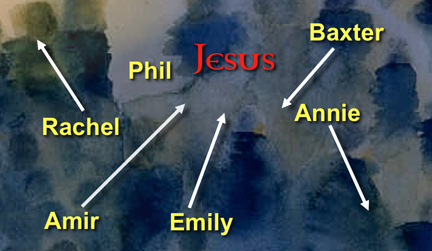
Many of us have gone down that road.  It’s endemic in the church culture.  We divide people into two groups: believers and unbelievers.  And then we draw a circle around ourselves and make it our mission to draw the outsiders into our circle.  “Conversion”, we call it.  “Wouldn’t you like to be one of us?”  The problem with this model is that it doesn’t seem to fit the method of Jesus.   He simply included everybody, and invited those who would to believe and follow Him.   The traditional evangelical model looks like this:

Phil and Rachel are “in.”  Amer, Emily and Baxter are “out,”  and we find Annie troublesome since she “converted” last year, but hasn’t done anything with it.  So … is she in or out, because we really need to know.

I think Jesus did it more like this:

He includes everyone and invites those who will to follow him.  Notice Rachel, Baxter, and Annie are going their own way, and Phil isn’t moving at all.  And yet they’re loved and invited to the party nevertheless.  Jesus breaks down every wall and calls us into His presence and our neighbor’s presence as well.  Maybe we ought to organize our own chorus and sing an anthem of inclusion.  I’ll bet the angels would gladly join in.

The Real Test

“Suppose one reads a story of filthy atrocities in the paper.” (And for the sake of making a point, suppose it regards a politician you dislike!)  “Then suppose that something turns up suggesting that the story might not be quite true, or not quite so bad as it was made out.  Is one’s first feeling, ‘Thank God, even they aren’t quite so bad as that,’ or is it a feeling of disappointment, and even a determination to cling to the first story for the sheer pleasure of thinking your enemies as bad as possible?  If it is the second then it is, I’m afraid, the first step in a process which, if followed to the end, will make us into little devils.  You see, one is beginning to wish that black was a little blacker.  If we give that wish its head, later on we shall wish to see grey as black, and then to see white itself as black.  Finally, we shall insist on seeing everything – God and our friends and ourselves included – as bad, and not be able to stop doing it: we shall be fixed forever in a universe of pure hatred.”

C.S Lewis, from Mere Christianity

Lewis’ brilliant point seems especially fitting in today’s polarized America.  I certainly had to stop and repent when I read it yesterday.

Only six more days before I return to Maryland and unpack my bags.  Since my last update I’ve had a splendid journey that’s reunited me with friends in Bosnia and Croatia, teaching at YWAM, Lausanne, (Switzerland), and then high in the Rockies above Denver in a School of Worship.  This week I’ll teach in a Discipleship Training School in Arvada, Colorada.  The trip has been full of grace and sweet surprises at every step along the way.  (And I never lost any luggage!)

Some of you will remember a year or so ago when I wrote about Nick Vujicic, the young Aussie who was born with no arms and legs.  He remains one of my heroes, and I hope to meet him one day.  But in the meantime, a friend just forwarded this extraordinary 20 minute film, The Butterfly Circus, that features Nick as the lead.  Grab some tissues before you watch, and be prepared to feel a WHOLE lot better about life at the end of the film.

WE are the problem…

“Influential Pastor Warns of Socialism, Departure from God.” So reads the headline of a video I recently viewed by a well known American preacher.  With the greatest respect, I beg to differ.  America faces the danger of Socialism precisely because the church has offered no alternative.  Let’s own up to some responsibility here.  It’s unfair to shove this mess off on unbelievers when we’re the ones who have failed so miserably at offering something better.  Yes, I know.  We preach heaven.  And that’s a very good thing when the time comes.  But we’re not there yet, and Jesus commissioned us to preach a message about the Kingdom of God, a message that touches every part of our metastasized nation.

Socialism has nothing to say about heaven, but much to say about life itself.   It offers inferior and ultimately unworkable answers to the problems of poverty, greed, health care, unemployment, labor, equality, and a host of other societal ills.  But the point is, it offers answers.  While the liberal media, Marxist professors and postmodern intellectuals of America at least have a plan in mind, the church wrings its hands and waits anxiously for Jesus to return and rescue us from this grand mess we’ve made of things.

Our last presidential election turned on the promise of “Hope and Change”, a distinctly Christian idea that finds its roots in the Scriptures.   Hope means we’re living in a story that has a good ending.   It means we’re going somewhere; that “the light shines on in the darkness, but the darkness has not mastered it. ” (John 1:5)   The kingdom means that we have a story, that we have answers for the problems that choke our nation because the King is all wise, and He reigns over a good, and beautiful and true kingdom.  It’s time we recovered that message and repented of our escape-centered gospel.

On a personal note, I had a splendid time with the DTS students at Holmsted Manor, (England), last week and then traveled by air, rail, and bus to Sarajevo, stopping for a day to visit some dear friends in Switzerland.  Bosnia is much as I left it, with many people still struggling to find hope and encouragement.  I’m spending leisurely hours with friends, listening to their stories of both victory and failure.   The relationships here are as rich and challenging as ever, and it feels like a grand gift to have this time to reconnect.   Next week I’ll return to Lausanne to teach at the base there.  Your prayers are always appreciated.